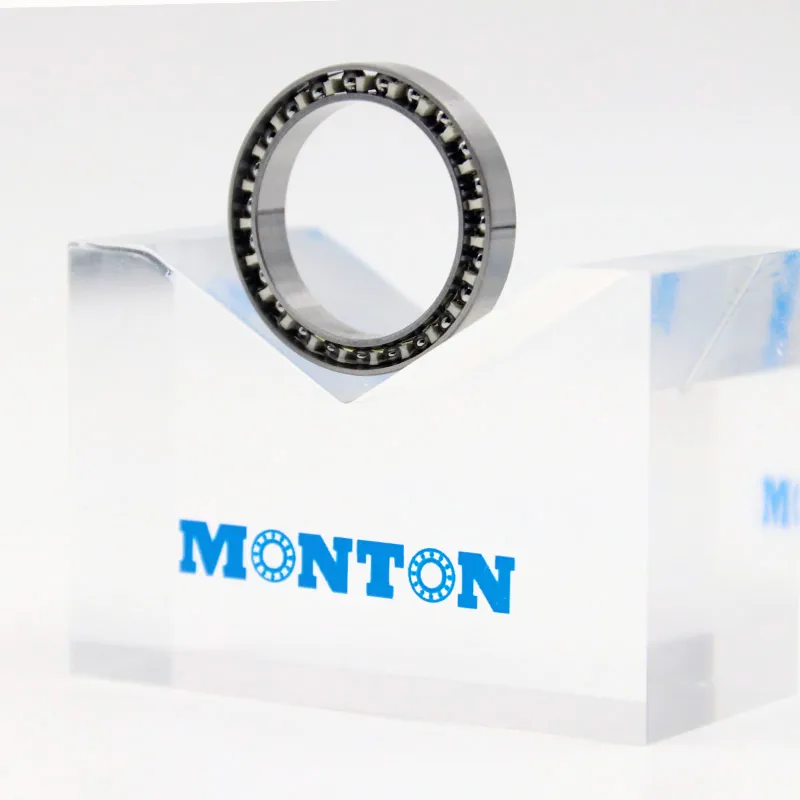
The determining factors of deformation of flexible bearings
Time: 2026-11-17 09:58:30
Source: Luoyang Monton Bearing Science & Technology Co.,ltd.
The deformation of a flexible bearing is jointly determined by four major dimensions: core driving factors, structural design, material properties, and external operating conditions. The specific influence mechanisms of each dimension are as follows:
1. Core Driving Factor: Wave Generator Cam Profile
The deformation of the inner and outer rings of a flexible bearing is directly determined by the profile of the elliptical cam of the wave generator, fully consistent with thin-walled ring deformation theory:
The inner ring has the maximum radial deformation at the major axis of the ellipse and the minimum at the minor axis, with zero radial deformation at approximately 45°.
The radial deformation distribution of the outer ring is consistent with that of the inner ring. The circumferential pre-deformation is zero at the major and minor axes and reaches a maximum at approximately 45°.
The maximum deformation of the inner ring is slightly larger than that of the outer ring, and the difference arises from the contact approach between the rolling elements and the raceways.
2. Structural Design Parameters
Ring Wall Thickness: The ring thickness of a flexible bearing is only 1/3 to 1/5 that of conventional bearings, typically ≤ 1 mm. The thinner the wall, the greater the deformation under the same external force, enabling controllable elastic deformation of ±5%.
Flexible Structure Optimization: Some products employ flexible hinge structures such as slots in the outer ring or wavy edges to concentrate deformation in designated areas, further lowering the stiffness threshold so that stable elastic deformation can be produced under small loads.
Fit Clearance Between Rolling Elements and Raceways: The original clearance directly affects the distribution ratio of pre-deformation after assembly. Excessive or insufficient clearance will change the final actual deformation.
3. Material and Heat Treatment Characteristics
Modulus of Elasticity of Materials: The modulus of elasticity of the base material, such as bearing steel, directly determines the stress-strain relationship and is a fundamental physical parameter for calculating deformation.
Heat Treatment Condition: Whether residual stresses are completely eliminated and the uniformity of the microstructure (e.g., degree of carbide segregation) affect the actual elastic behavior of the material. Unreleased residual stresses can cause additional aging deformation.
Application of Special Elastic Materials: Some flexible adaptive bearings incorporate polyurethane or polyimide elastic compensation layers on the mating surfaces, using the material's own slight deformation to help adjust the overall deformation distribution.
4. External Operating Conditions
Working Load: Additional radial and axial loads during actual operation superimpose extra deformation on the assembly pre-deformation. Loads exceeding 30% of the rated value will cause significant excessive deformation.
Temperature Environment: Thermal expansion and contraction caused by poor lubrication or sudden changes in ambient temperature alter the actual dimensions of the rings, indirectly changing the equivalent deformation. A local temperature rise exceeding 120°C may also cause material softening and permanent deformation.
Assembly Precision: Assembly issues such as out-of-tolerance flatness of the mounting surface or excessive interference fit introduce additional stress, causing local deformation to exceed the design range.